
L-1A New Office Questions Answered: Hiring, Office Space, Remote Staff, and Filing Timing
Founders preparing an L-1A new office filing usually ask practical questions first. How many U.S. employees are needed in the first year? Is there a required office size? Will coworking space work? Can staff work remotely? Do premises need to be secured before Form I-129 is filed? These are sensible questions, but in an L-1A new office case they should be understood for what they really are: questions about credibility, structure, and first-year viability. USCIS’s published standard is not simply that the business look real in a general commercial sense. It is that the petitioner show, among other things, that sufficient physical premises have been secured and that the new office will support an executive or managerial position within one year.
That distinction matters because many weak filings are not weak businesses. They are weak explanations. A generic L-1 business plan may describe market opportunity, services, and revenue potential, yet still leave unresolved the issues USCIS is actually trying to understand in a new office case: who will perform routine work, whether the premises fit the planned operation, how the U.S. entity will function in the first year, and whether the beneficiary’s role will truly be executive or managerial rather than hands-on operational. USCIS’s policy manual emphasizes that executive or managerial capacity turns on the actual nature of the duties and the organizational context around the role, not title alone.
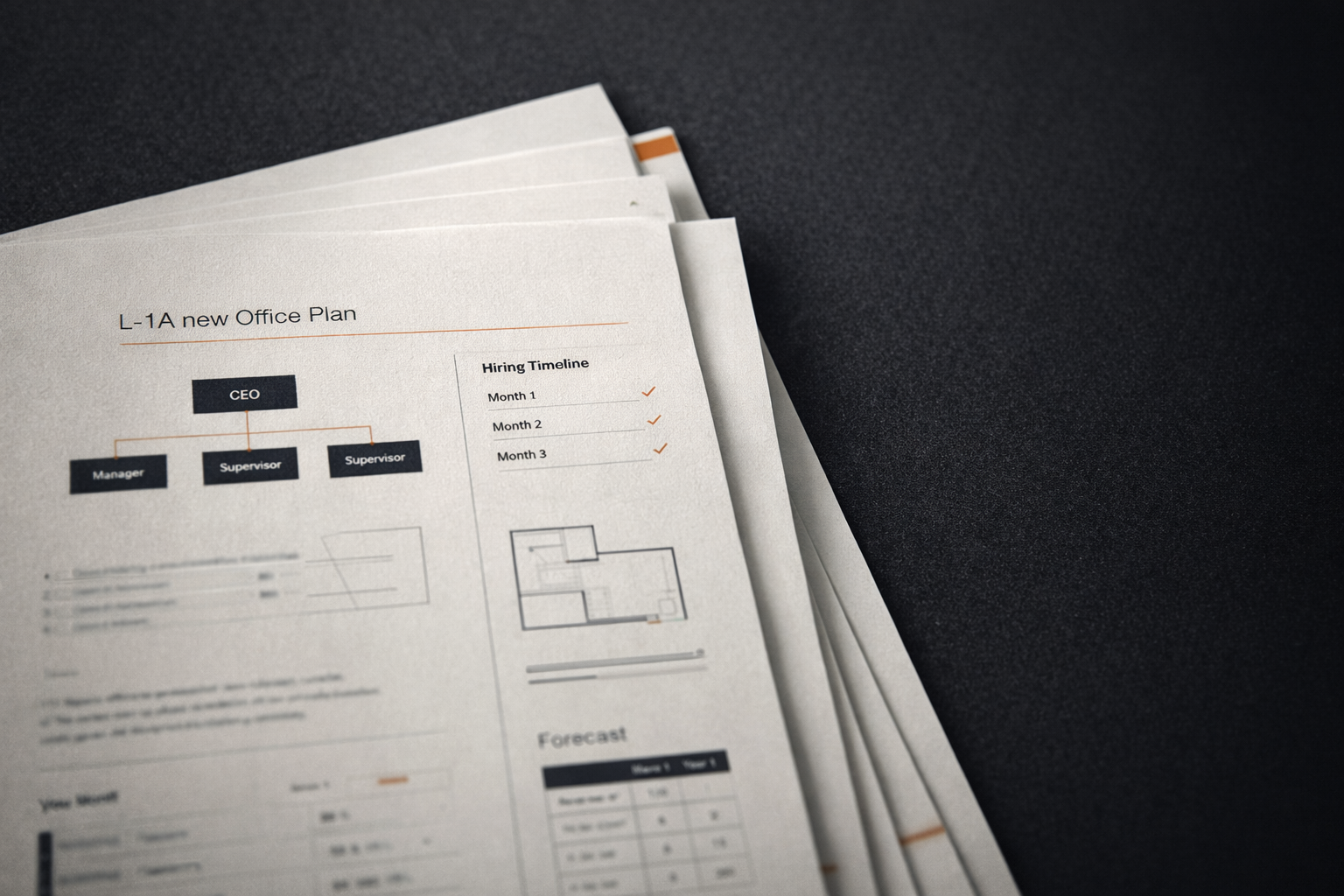
The central issue is not checklist compliance. It is whether the first-year structure looks believable.
A standard startup plan can often survive abstraction. An L-1 visa expansion business plan usually cannot. USCIS’s new office materials point back to a narrower set of concerns: the proposed nature of the office, its organizational structure, its financial goals, the size of the U.S. investment, the foreign entity’s structure, sufficient physical premises, and whether the operation will support a qualifying executive or managerial position within one year.
That is why the best answers to L-1A new office questions are rarely one-word answers. “Yes,” “no,” or “maybe” usually misses the point. The real issue is whether the facts line up into a coherent first-year operating narrative that makes the role, staffing, and physical setup credible together. That is a much more demanding standard than simply filling in standard business-plan sections.
Is there a required minimum number of U.S. employees in the first year?
USCIS does not set a universal minimum number of U.S. employees for every L-1A new office petition. The relevant standard is whether the intended U.S. operation will support an executive or managerial position within one year, viewed in light of the proposed nature of the office, its organizational structure, financial goals, and business and hiring plan.
In practice, that means the more useful question is not “What is the minimum number?” but whether the planned staffing structure makes the claimed role credible. The issue is not headcount in the abstract. It is whether the business will be organized in a way that relieves the beneficiary from primarily performing routine operational work.
A filing can therefore be weak even with several projected employees if the hierarchy is unclear, the roles are thinly described, or the plan still implies that the beneficiary will personally handle day-to-day operations. Conversely, the issue is not solved by citing an arbitrary employee number. In an L-1A new office case, staffing matters because it supports role credibility, not because USCIS publishes a magic threshold.
What are the hiring requirements for U.S. employees in terms of pay and minimum wage?
USCIS’s L-1A new office guidance does not create a special standalone wage schedule for newly hired U.S. employees as part of the L-1A standard itself. But regular U.S. wage-and-hour law still applies. The U.S. Department of Labor states that covered nonexempt workers are entitled to a federal minimum wage of at least $7.25 per hour and overtime of at least one and one-half times the regular rate after 40 hours in a workweek. The Department also states that where both state and federal minimum wage laws apply, the employee is entitled to the higher minimum wage.
For an L-1 visa business plan, that matters less as a technical HR footnote and more as a credibility issue. A hiring plan that looks commercially disconnected from the actual wage environment of the intended state or city can make the broader business plan feel generic. The point is not simply to mention payroll. It is to make the staffing assumptions look plausible in the real market where the business expects to operate. That is one of the places where a generic AI draft often sounds polished but fails to reflect real-world operating logic.
Is there a required minimum square footage for the office?
USCIS requires that the employer secure sufficient physical premises to house the new office, but the materials I reviewed do not set a universal square-footage minimum. In a published AAO decision, USCIS noted that the phrase “sufficient physical premises” is broad and somewhat subjective, and that the petitioner bears the burden of showing why the premises are sufficient in light of the nature of the business, the type and amount of space needed, the proposed staffing levels, and expected first-year growth.
That is a more nuanced standard than many online discussions suggest. The question is not whether a particular number of square feet sounds respectable in the abstract. The question is whether the premises fit this specific business, this claimed staffing path, and this first-year operating plan. A very small footprint may be perfectly logical for one business model and much harder to defend for another. In other words, office sufficiency is contextual, not formulaic.
Will coworking space or leased desk space suffice?
There is no official USCIS rule I found saying that coworking space or leased desk space is automatically disqualifying. But there is also no blanket approval rule. The same governing standard still applies: the petitioner must show sufficient physical premises and readiness to commence doing business in a way that supports the claimed role within one year. AAO decisions emphasize both the sufficiency of the premises and the requirement that eligibility exist at the time of filing.
So the better way to think about coworking is not as a yes-or-no category issue. It is a fit issue. If the business model, operating footprint, and early staffing logic make a flexible office arrangement look commercially coherent, the argument is easier. If the plan describes a larger operational presence but the premises evidence looks too thin, the filing can begin to feel borrowed or underdeveloped. The label on the space matters less than the relationship between the space and the claimed operation.
Must U.S. employees physically work in the leased office?
In the USCIS materials I reviewed, I did not find a blanket rule stating that all U.S. employees in an L-1A new office case must physically work from the leased office. The published USCIS framework focuses instead on sufficient physical premises, the proposed nature and scope of the office, and the question of whether the operation will support an executive or managerial role within one year.
That does not mean remote staffing is irrelevant. It means the remote-work question has to be integrated into the broader office narrative. If a petition describes a business with multiple employees, meaningful operating activity, and a substantial first-year growth plan, but the premises story is minimal and the remote-work logic is barely explained, USCIS may view the overall structure as thin. The issue is not whether remote work is theoretically permitted in a modern business. The issue is whether the filing still presents a coherent and credible new office structure.
Do you need to secure office space before filing Form I-129?
Yes. This is one of the clearer parts of the new office framework. USCIS’s L-1A page says the employer must have secured sufficient physical premises to house the new office. USCIS’s 2012 new office guidance and multiple AAO decisions also treat proof of physical premises as required initial evidence. AAO decisions further state that a petitioner must establish eligibility at the time of filing and may not rely on later-acquired facts to cure an ineligible filing.
That point is easy to underestimate because it sounds administrative. It is not. In a serious business plan for L-1 visa purposes, the premises issue is part of the case theory. It helps show operational readiness. If the office has not been credibly secured at filing, the petition is exposed at a threshold level before the rest of the business narrative has much room to help.
What these questions are really testing
Taken together, these questions are testing one underlying issue: whether the filing looks ready, specific, and structurally coherent. USCIS is not simply asking whether the company could exist. It is asking whether the new office, as documented, will be able to support an executive or managerial position within one year, with sufficient premises, credible operating scope, and a staffing path that makes the role believable.
That is why a weak L-1 visa business plan often feels incomplete even when it contains the usual sections on market, services, and projections. The problem is usually not lack of text. It is lack of alignment. Hiring assumptions, office footprint, remote-work logic, and filing timing all need to point toward the same first-year reality. When they do not, the plan begins to look generic.
Why generic templates and AI drafts often handle these questions poorly
Generic templates tend to treat these issues as isolated boxes to complete: employee count, office address, payroll line, remote policy. Generic AI drafts often do the same thing in smoother language. But USCIS’s actual framework is more contextual. The agency is looking for sufficient premises, the proposed nature and structure of the office, the financial and organizational basis of the operation, and credible support for a managerial or executive role within one year.
That is why these questions should not be treated as minor technicalities. In a serious new office filing, they are often where a document either starts to look case-specific or starts to look borrowed. A strong plan does not answer them mechanically. It answers them as part of one integrated operating narrative.
Final thought
The most useful answer to common L-1A new office questions is rarely a shortcut. USCIS does not publish a universal minimum headcount rule or a one-size-fits-all office-size rule. What it does require is more exacting: a petitioner that has secured sufficient premises, is ready to commence doing business, and can credibly show that the U.S. office will support an executive or managerial position within one year.
That is why hiring, office space, remote-work arrangements, and filing timing should not be treated as separate tactical issues at the margins of a plan. In a real L-1 visa expansion business plan, they are part of the same evidentiary story.
For founders and attorneys who need anL-1 visa business plan servicebuilt around new-office review logic rather than generic startup formatting, Robinomics Consulting provides research-driven drafting support for high-stakes filings.
This article is for general informational purposes only and does not constitute legal advice. Immigration strategy, filing posture, and employment-law compliance depend on the full facts of the case and, where appropriate, advice from qualified counsel and compliance professionals.