
E-2 Marginality Explained: How Business Plans Demonstrate Growth
Of all E-2 requirements, marginality is the one most frequently misunderstood—and most likely to trigger additional scrutiny. Unlike the “substantial investment” requirement (which is largely evidenced through expenditures and documentation), marginality is a forward-looking test. The officer evaluates whether the enterprise has credible capacity to generate economic value beyond supporting the investor’s household.
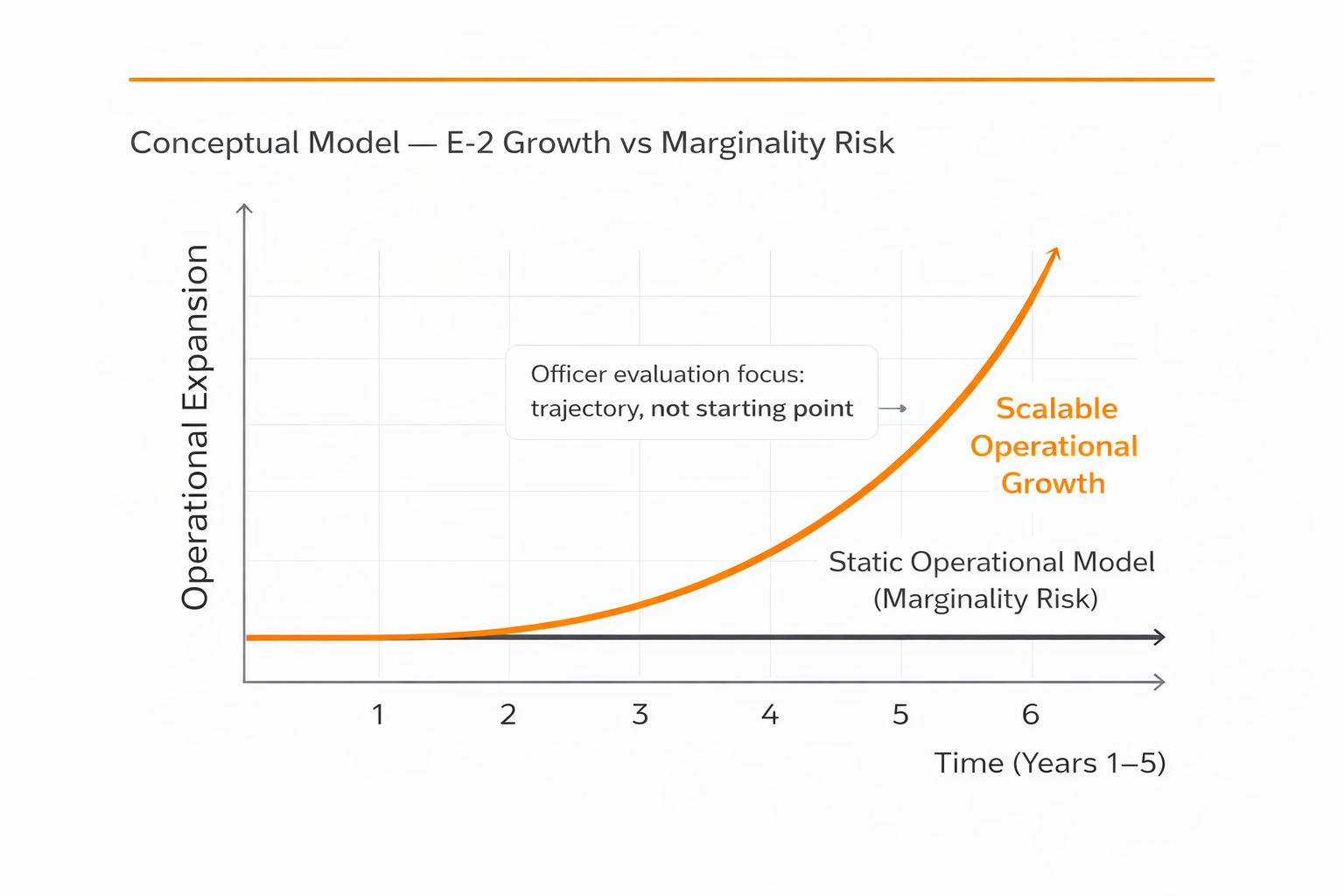
If an adjudicator concludes the enterprise is “marginal,” the practical concern is usually this: the business resembles self-employment (or a “job purchase”) rather than a scalable commercial operation.
Important: This article is informational and not legal advice. Always coordinate case strategy with your immigration attorney.
The Legal Definition: More Than a Minimal Living
The Foreign Affairs Manual (FAM) describes a marginal enterprise as one that does not have the present or future capacity to generate more than enough income to provide a minimal living for the treaty investor and their family.
In practical terms, the E-2 program is designed to support active, operating businesses that contribute to the U.S. economy—not arrangements that simply replace employment income for the investor.
Two Ways to Overcome a Marginality Concern
An applicant can generally rebut marginality through either current income or future capacity.
Current income means the business is already producing income that clearly exceeds a minimal living threshold, which is less common for true startups.
Future capacity means the business plan credibly demonstrates that, within a reasonable timeframe (commonly evaluated across a five-year plan horizon), the enterprise will generate meaningful economic activity.
Because many E-2 filings involve new or recently acquired businesses, the future-capacity argument often carries most of the burden—and that burden is won or lost on plan credibility.
How Adjudicators Evaluate Marginality in Practice
Although marginality is defined legally, officers rarely assess it using a single number. In real case review, adjudicators often evaluate organizational trajectory: whether the enterprise shows characteristics of a business that can scale, hire, and operate beyond the investor’s personal labor.
Organizational Structure vs. Self-Employment
A central question is whether the business functions as an enterprise rather than a role created for the investor. Plans that show the investor personally performing most revenue-generating and operational functions for multiple years can resemble self-employment—especially where revenue is directly tied to the investor’s hours.
Operational Scaling Indicators
Officers look for mechanisms that allow growth without simply increasing the investor’s workload. Growth that depends on working more is less persuasive than growth driven by capacity expansion, such as staffing, systems, equipment, locations, or repeatable processes.
Reinvestment vs. Income Extraction
A common credibility check is whether projected profits are reinvested into the business (marketing, hiring, equipment, expansion) or primarily extracted as owner income. A plan that appears designed to maximize owner withdrawals early can raise marginality concerns—even if technically profitable.
Economic Dependency Beyond the Investor
Non-marginal businesses typically create broader economic relationships: employees, contractors, suppliers, service providers, and other local spending. Where W-2 hiring is limited, the plan must still make economic contribution visible through other measurable channels.
Marginality is often an evidence-and-trajectory question rather than a single profit number.
How the Business Plan Demonstrates Non-Marginality
A standard SBA-style plan often emphasizes feasibility and stability. An E-2 business plan must also demonstrate credible growth capacity and economic contribution. In practice, three evidence markers matter most.
1. The Personnel Plan: Job Creation and Operational Leverage
Hiring is one of the clearest indicators that an enterprise operates beyond the investor’s personal income needs. However, generic statements like “we plan to hire in the future” are rarely persuasive on their own.
A strong E-2 plan typically includes a five-year organizational chart that evolves over time, a role-based hiring plan, and a staffing timeline aligned with operational milestones and demand drivers.
An illustrative trajectory:
Year 1: Investor supported by one or two essential roles removing operational bottlenecks.
Years 2–3: Additional roles added as volume grows.
Years 4–5: Management or supervisory roles and further specialization as the company matures.
If revenue grows while headcount remains flat, the plan can appear structurally inconsistent.
2. The Financial Growth Curve: Realistic Scaling, Not a Flat Line
Officers evaluate whether projections are internally consistent, market-aligned, and operationally plausible.
Common issues:
Stagnation: flat revenues and flat operations over multiple years
Overstatement: aggressive growth without credible drivers
A non-marginal trajectory typically shows:
Reasonable growth supported by market size and customer acquisition logic
Reinvestment into the business rather than immediate extraction of profits
Net income that does not appear designed solely to fund the investor’s household
3. Economic Impact Beyond Jobs: Making Contribution Visible
Some E-2 businesses rely more heavily on contractors and outsourced functions rather than W-2 staff in early stages. The plan must still demonstrate measurable economic activity beyond the investor.
Examples include vendor spending, contractor ecosystems, local operating expenses, and a credible tax footprint.
Indirect impact must be specific and consistent with the operating model.

Common Marginality Red Flags in Business Plans
When we audit business plans written by non-specialists, we often see these errors that trigger Requests for Evidence (RFEs):
The "Solopreneur" Trap: A plan that shows the investor doing everything (sales, admin, delivery) for 5 years with no support staff.
Inconsistent Salaries: Projecting an employee salary that is below the legal minimum wage or local standard, just to make the profit margins look higher.
Lifestyle Businesses: Businesses that appear to be hobbies or passive investments (like owning a single vacation rental) rather than active commercial enterprises.
Understanding marginality requires more than general business planning — it requires projections and organizational structures aligned with how E-2 adjudications are evaluated in practice. A properly structured E-2 visa business plan connects hiring timelines, operational scalability, and financial growth assumptions into a coherent framework designed for immigration review. If you are assessing whether your projections and strategy would withstand scrutiny, our E-2 visa business plan services focus specifically on developing data-driven plans aligned with USCIS and consular expectations.
Summary: Treat Marginality as an Evidence Problem
Marginality is less about a single profit number and more about whether the enterprise demonstrates credible economic trajectory.
A strong E-2 business plan shows:
A realistic staffing plan tied to operational milestones
A coherent financial growth curve grounded in market reality
Measurable economic contribution beyond the investor
When the plan is internally consistent, market-supported, and operationally scalable, it becomes substantially easier to demonstrate that the enterprise is not marginal.